Dental Implants in Greenville, SC | Evelina Smiles

Dental Implants in Greenville, SC
Evelina Smiles | Dr. Rich Constantine | Fountain Inn, South Carolina
A dental implant does more than fill the space left by a missing tooth. It replaces the support of the missing tooth root within the jawbone, creating a stable foundation for a new tooth.
For a single missing tooth, a small titanium implant is placed into the jawbone and restored with a custom crown. Unlike a traditional bridge, an implant can replace the missing tooth without requiring healthy neighboring teeth to be reshaped for support.
But dental implants aren't limited to replacing individual teeth.
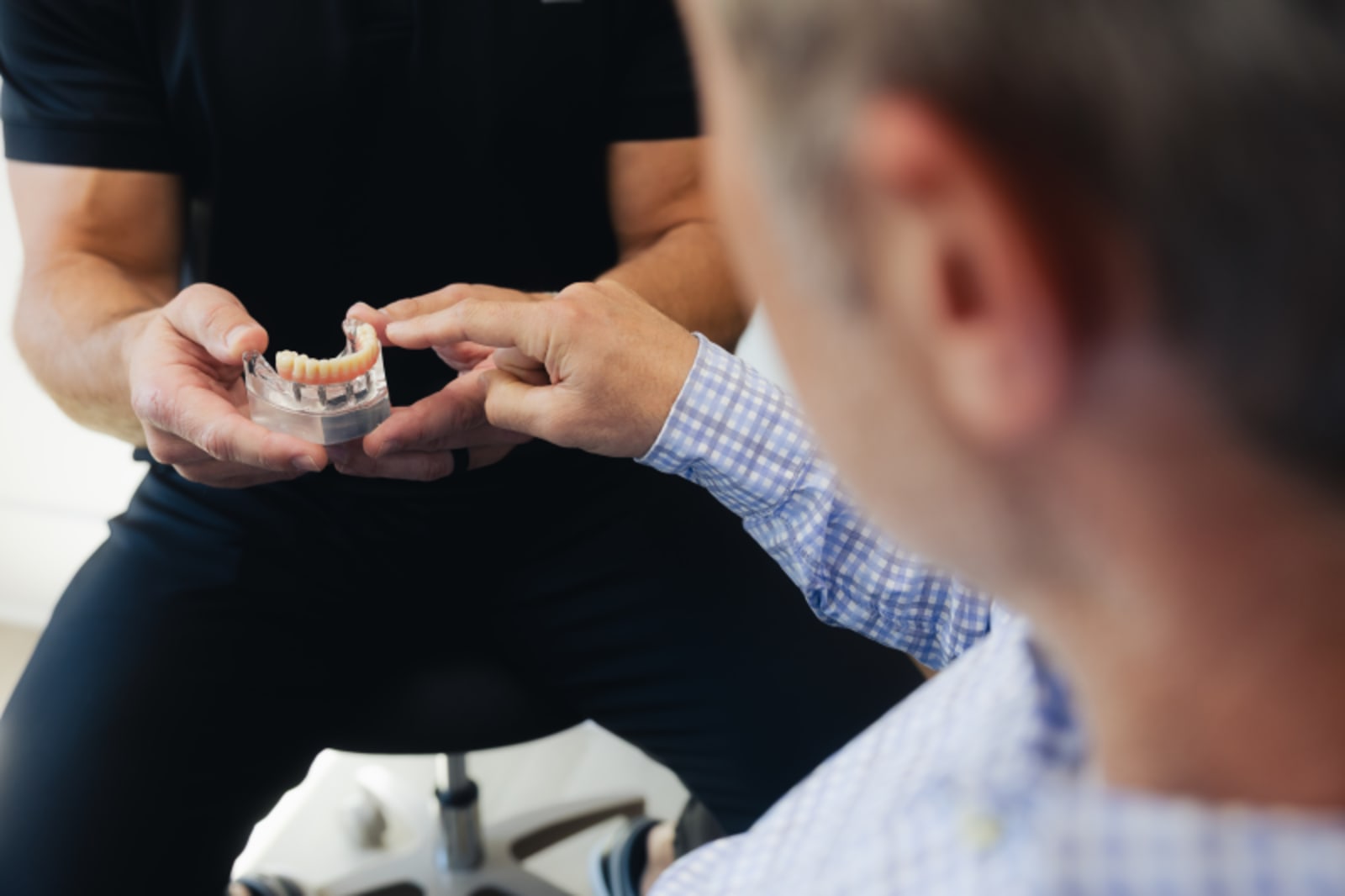
If you're missing several teeth, implants can support a fixed bridge and may eliminate the need for a removable partial denture. If you're missing all or most of your teeth, implants can provide stability for a removable overdenture or support a fixed full-arch restoration such as All-on-X.
At Evelina Smiles in Fountain Inn, SC, Dr. Rich Constantine provides comprehensive implant treatment, from diagnosis and 3D planning through implant placement and the final restoration. When clinically appropriate, procedures such as extractions, bone grafting, sedation, and restorative treatment can also be coordinated through our practice.
That means we're not simply thinking about where an implant can be placed.
We're planning around the teeth we ultimately want the implants to support.
If you're considering dental implants in Fountain Inn, Simpsonville, Greenville, or the surrounding Upstate, understanding your options is the first step. This guide explains how implants work, who may be a candidate, what recovery is really like, and what to consider when choosing an implant dentist.
Quick Takeaways
- Dental implants replace the support of missing tooth roots. They are placed within the jawbone and can support individual crowns, bridges, overdentures, or fixed full-arch restorations.
- • You don't necessarily need one implant for every missing tooth. Strategically positioned implants can support multiple replacement teeth.
- • Implants can help preserve bone where they are placed. This is an important difference between implants and conventional bridges or dentures.
- • Healthy neighboring teeth generally don't need to be altered. Unlike a traditional bridge, a single-tooth implant stands independently.
- • Bone loss doesn't automatically rule out dental implants. Bone grafting and other procedures may help create the foundation needed for implant placement.
- • Most patients are surprised by how manageable implant recovery can be. Many patients return to work and normal daily activities within a day or two after straightforward implant placement, even though the implant continues healing within the bone for several months.
- • Healthy gums matter. Active periodontal disease should be controlled before implant placement.
- • Sedation options are available. Evelina Smiles offers oral conscious sedation and IV sedation for appropriate patients.
- • Dental implants require long-term maintenance. Good home care and professional dental visits help protect the gum and bone surrounding your implants.
How Dental Implants Work, Step by Step
A dental implant restoration typically has three primary components: the implant, an abutment or connector, and the visible restoration.
For a single missing tooth, that restoration is usually a crown.
For multiple missing teeth, implants can support a bridge, overdenture, or full-arch restoration.
1. Consultation and 3D Imaging
Treatment begins by understanding the entire picture.
At Evelina Smiles, we evaluate your teeth, gum health, bite, available space, medical history, bone, and what you ultimately want your replacement teeth to provide.
Cone beam CT technology gives us a three-dimensional view of your jaw, including the height and width of available bone and the location of important anatomical structures such as nerves and sinuses.
This helps Dr. Constantine determine not only whether an implant is possible, but also where an implant should ideally be positioned to support the planned final restoration.
If bone or gum tissue needs additional preparation, we'll discuss that before moving forward.
2. Implant Placement
The dental implant is a small titanium post placed into the jawbone in the area of the missing tooth root.
The treatment area is thoroughly anesthetized with local anesthesia before implant placement. For patients who are anxious about treatment or undergoing more extensive procedures, sedation can also be incorporated into the treatment plan when appropriate.
3. Healing and Osseointegration
After placement, bone gradually integrates with the surface of the implant through a biological process called osseointegration.
This creates the stable foundation that allows the implant to support a replacement tooth or teeth.
It's important to distinguish this biological healing process from how long you actually feel like you're recovering.
Although osseointegration typically continues for several months, many patients are surprised by how manageable the initial recovery can be. Following straightforward implant placement, many patients return to work and normal daily activities within a day or two.
Some soreness, tenderness, bruising, or swelling is normal during the first several days. Following your post-operative instructions is important for comfortable and predictable healing.
Depending on your treatment and the location of the missing tooth, a temporary tooth may also be available while the implant heals.
4. Restorative Connection
Once the implant has achieved appropriate integration and stability, it can be connected to the planned restoration.
For a single tooth, an abutment typically connects the implant to the crown.
The exact restorative process is different for implant bridges, overdentures, and full-arch restorations.
5. Your Final Tooth or Teeth
The final restoration is designed around more than simply filling an empty space.
We consider shape, size, contour, bite, cleansability, appearance, and how the restoration relates to the surrounding teeth and tissues.
For a single implant, the goal is to create a tooth that blends naturally into your smile while functioning as part of your bite.
For patients replacing multiple or all of their teeth, the planning becomes even more comprehensive because we're rebuilding a larger portion of the smile.
What You Gain From a Dental Implant
Stability
Because an implant is anchored within the jawbone, it creates a stable foundation for the restoration it supports.
That stability can be especially meaningful when comparing implant-supported teeth with removable partial or complete dentures.
The Ability to Preserve Healthy Neighboring Teeth
A traditional bridge commonly relies on the teeth beside a missing tooth for support. Those teeth usually need to be prepared for crowns.
A single dental implant stands independently.
If the neighboring teeth are healthy, this can allow us to replace the missing tooth without unnecessarily altering them.
There are situations where a traditional bridge is still an excellent choice—particularly when neighboring teeth already require crowns—but patients should understand both options before deciding.
Support for the jawbone
When a natural tooth root is lost, the surrounding bone no longer receives the same functional stimulation and gradually remodels.
Because an implant is integrated within the jawbone, functional forces can be transferred through the implant into the surrounding bone.
Dental implants don't prevent every biological or age-related change in the jaws, but they can help preserve bone in the areas where they are placed.
Fixed Replacement Teeth
One of the greatest advantages of implants is their versatility.
Dental implants can support:
• A single fixed crown
• A fixed implant bridge replacing several teeth
• A removable implant-supported overdenture
• A fixed full-arch restoration such as All-on-X
That means patients who would otherwise require a removable partial or complete denture may have another option.
A Natural-Looking Result
For a single implant, the crown can be designed to complement the surrounding teeth in shape, proportion, contour, and shade.
For more extensive implant treatment, we consider the entire smile, including tooth position, facial support, bite, and overall appearance.
Long-Term Maintainability
Implants still require maintenance.
Single implant crowns are generally cared for similarly to natural teeth, although careful cleaning around the implant is important.
Implant bridges and full-arch restorations require specialized cleaning around and underneath the prosthesis.
Our goal is not only to create an attractive result, but also one you can maintain over time.
What If You're Missing Several Teeth?
One of the biggest misconceptions about implant dentistry is that every missing tooth requires an individual implant.
It doesn't.
Implant-Supported Bridges
If you're missing several adjacent teeth, two or more implants may be able to support several fixed replacement teeth.
For the right patient, this can provide an alternative to wearing a removable partial denture.
Implant-Supported Overdentures
For patients missing an entire arch of teeth, dental implants can provide additional retention and stability for a removable denture.
An implant-supported overdenture still comes out for cleaning, but it connects to implants rather than relying entirely on the gums, suction, or adhesive for retention.
This can be particularly valuable for patients struggling with a loose lower denture.
All-on-X and Fixed Full-Arch Dental Implants
For patients who want a fixed alternative to removable dentures, several strategically positioned implants may be used to support an entire arch of replacement teeth.
This approach is often referred to as All-on-X or fixed full-arch implant treatment.
Rather than placing an implant for every missing tooth, an appropriate number of implants is selected based on the patient's bone, anatomy, bite, restoration, and treatment goals.
The final prosthesis is secured to the implants and isn't routinely removed by the patient.
If you're facing the loss of most or all of your teeth, we believe it's worth understanding whether an overdenture or fixed full-arch solution is possible before assuming conventional dentures are your only choice.
Who Is a Good Candidate for Dental Implants?
Many adults can be considered for implant treatment, but candidacy is individualized.
Available Bone
An implant needs sufficient bone to achieve stability.
If a tooth has been missing for a long time—or bone has been lost because of periodontal disease—additional treatment may be necessary.
But being told you have bone loss does not automatically mean you can't have dental implants.
Depending on your anatomy, bone grafting, sinus grafting, or another approach may help create the foundation needed for implant treatment.
Healthy Gums
Healthy gum and bone tissue are important for the long-term health of dental implants.
Active periodontal disease should be addressed before implant placement.
Overall health
Your health history is an important part of implant planning.
Certain medical conditions and medications can influence healing, but a well-managed medical condition doesn't automatically prevent someone from receiving dental implants.
When necessary, treatment can be coordinated with your physician.
Smoking
Smoking can negatively affect healing and increase the risk of implant complications.
If you smoke, it's important to discuss this openly with Dr. Constantine so it can be considered when evaluating your treatment.
Age
There isn't a simple upper age limit for dental implants.
Overall health, bone, oral health, and healing ability are generally more important than age alone.
Your Dental Implant Timeline
Dental implant treatment is usually measured in months, but most of that time isn't spent in the dental chair.
It's healing time.
A straightforward single implant may generally progress through:
- Consultation and Planning: Examination, 3D imaging, diagnosis, treatment options, timeline, and financial review.
- Site Preparation: If necessary, treatment may include extraction, periodontal therapy, bone grafting, or other preparation.
- Implant Placement: The implant is placed within the jawbone.
- Initial Recovery: Many patients return to work and normal daily activity within a day or two following straightforward implant placement.
- Osseointegration: Over the following months, bone continues to integrate with the implant.
- Final Restoration: Once appropriate healing and stability have been achieved, the implant can receive its final crown, bridge, overdenture, or other restoration.
If grafting is necessary, treatment may take longer.
Full-arch implant treatment follows a different timeline, and some appropriately selected patients may be candidates for temporary fixed teeth around the time their implants are placed.
Dr. Constantine will explain what is realistically possible for your specific situation before treatment begins.
Preparing for Implant Treatment

Before treatment, make sure our team has an accurate list of your medications and medical conditions.
If sedation is planned, we'll provide specific instructions regarding eating, drinking, medications, and transportation.
Having soft foods available at home can also make the first few days after surgery easier.
long term. If you grind or clench your teeth, a nightguard may also help protect your restoration.
What Is Dental Implant Recovery Really Like?
This is one area where patients are often pleasantly surprised.
The time it takes an implant to completely integrate with the bone is very different from the amount of time most patients feel like they're recovering from the procedure.
Some swelling, tenderness, or soreness is expected after implant placement.
For many straightforward cases, the most noticeable symptoms occur during the first few days and then begin improving.
Many patients find they're able to return to work and most normal daily activities within a day or two.
It's still important to follow your post-operative instructions carefully. Certain foods, strenuous activities, smoking, and other behaviors can interfere with early healing even when you feel good.
Beneath the surface, your implant will continue integrating with the surrounding bone for several months.
Feeling back to normal doesn't mean the biological healing process is finished.
Long-Term Dental Implant Care
Dental implants cannot develop cavities, but the tissues supporting them can still develop inflammation or infection.
This is why professional maintenance and good home care remain important after implant treatment.
Long-term care may include:
• Brushing thoroughly every day
• Cleaning between implants and neighboring teeth
• Cleaning beneath implant bridges or full-arch restorations
• Following your recommended professional hygiene schedule
• Monitoring the gums for changes
• Wearing a nightguard when recommended
• Avoiding tobacco
• Addressing problems early
An implant is an investment in your oral health.
Maintenance helps protect that investment.
Dental Implant Cost, Insurance, and Payment Options
There isn't one standard price for dental implant treatment because there isn't one standard implant case.
Your overall investment may depend on:
• How many teeth you're replacing
• How many implants are needed
• Whether teeth need to be removed
• Available bone
• Whether bone or sinus grafting is necessary
• Type of final restoration
• Materials
• Complexity
• Sedation
A single implant and crown is very different from an implant bridge.
An overdenture is different from an All-on-X fixed restoration.
That's why we believe the first step is determining what treatment actually makes sense for you before comparing prices.
After your examination and imaging, we'll explain your recommendations and provide an estimate of the anticipated investment.
Dental insurance benefits vary considerably. Depending on your plan, benefits may be available for certain portions of treatment.
Evelina Smiles also offers financing options for qualified patients, as well as the Evelina Smiles Wellness Plan for patients without traditional dental insurance.
Are Dental Implants Worth the Investment?
Dental implants generally require a larger initial investment than conventional partials or dentures.
But price alone doesn't tell the entire story.
When comparing tooth replacement options, consider:
• Stability
• Chewing ability
• Whether your teeth are fixed or removable
• Effect on neighboring teeth
• Bone preservation
• Comfort
• Appearance
• Maintenance
• Expected longevity
• Future repair or replacement
• Treatment time
• Overall financial investment
The question isn't simply: “What costs the least today?”
It may be more useful to ask: “How do I want my replacement teeth to look, feel, and function for the years ahead?”
Why Choose Dr. Rich Constantine and Evelina Smiles for Dental Implants?

Dental implant treatment requires more than placing an implant into the jawbone.
The bone, gum tissue, implant position, bite, appearance, final restoration, and long-term maintenance all need to work together.
Experience in Implant Dentistry
Dr. Rich Constantine has years of experience placing and restoring dental implants and has continued to pursue advanced education in implant dentistry throughout his career.
In addition to treating patients at Evelina Smiles, Dr. Constantine serves as a faculty member and clinical mentor with Implant Pathway in Gilbert, Arizona, where he helps train dentists in the clinical aspects of implant dentistry.
That experience influences a fundamental principle behind implant treatment at Evelina Smiles:
We plan with the final result in mind from the beginning.
Comprehensive Implant Treatment
Depending on your individual needs, treatment at Evelina Smiles may include:
• Tooth extraction
• Bone grafting
• Sinus grafting
• Implant placement
• Single implant crowns
• Implant-supported bridges
• Implant overdentures
• All-on-X and fixed full-arch treatment
• Sedation dentistry
• Long-term implant maintenance
Keeping multiple phases of treatment coordinated through one practice when appropriate can simplify communication and help ensure everyone is working toward the same final result.
Advanced 3D Planning
Cone beam CT imaging provides detailed three-dimensional information about your bone and anatomy.
We combine this information with an evaluation of your teeth, bite, gums, smile, and desired restoration to plan treatment comprehensively.
Sedation Options
Dental anxiety shouldn't prevent you from exploring dental implants.
Oral conscious sedation and IV sedation are available for appropriate patients depending on medical history and planned treatment.
Clear Explanations
At Evelina Smiles, Care, Confidence, and Clarity are more than words.
We want you to understand what we see, what your options are, why we're recommending a particular approach, and what you can realistically expect.
Our job isn't simply to tell you what treatment you need.
It's to give you the information you need to make a confident decision about your health and smile.
Frequently Asked Questions
Does Getting a Dental Implant Hurt?
The treatment area is thoroughly anesthetized before implant placement.
Some soreness, swelling, tenderness, or bruising can occur afterward, but many patients are surprised by how manageable recovery is.
For straightforward implant placement, many patients return to work and normal daily activities within a day or two.
Sedation options are also available for appropriate patients who are anxious about treatment.
Will I Have a Gap While My Implant Heals?
Not necessarily.
Depending on the location of the missing tooth, your bite, and your treatment plan, a temporary tooth may be available while your implant heals.
How Long Do Dental Implants Last?
Dental implants are intended as a long-term tooth replacement solution.
With appropriate treatment planning, good home care, professional maintenance, and favorable health factors, implants can function for many years and sometimes decades.
The restoration attached to an implant experiences normal wear and may eventually require maintenance, repair, or replacement.
Can I Get an Implant If My Tooth Has Been Missing for Years?
Possibly.
Bone gradually changes after a tooth is lost, but that doesn't automatically mean implant treatment is no longer possible.
3D imaging allows Dr. Constantine to evaluate the amount and location of available bone and determine whether an implant can be placed or whether grafting or another approach should be considered.
How Are Implants Different From Bridges?
A traditional bridge replaces a missing tooth by using neighboring teeth for support. Those teeth commonly need to be prepared for crowns.
A dental implant receives its support from within the jawbone and generally doesn't require healthy neighboring teeth to be altered.
Bridges can be an excellent option in the right situation, particularly when adjacent teeth already require crowns.
However, if those teeth are healthy, an implant may allow us to replace the missing tooth independently.
What If I'm Missing Several Teeth?
You don't necessarily need an individual implant for every missing tooth.
Depending on your situation, implants may support a fixed bridge, removable overdenture, or fixed full-arch restoration.
What If I Already Wear Dentures?
You may still be a candidate for implants.
Implants can sometimes be used to stabilize a removable overdenture or support a completely fixed full-arch restoration.
If you've worn dentures for many years, 3D imaging is particularly useful because it allows us to evaluate how much bone remains and what treatment options may be realistic.
Take the Next Step When You're Ready
You don't need to know which implant treatment you need before scheduling a consultation.
That's what the consultation is for.
If you're missing one tooth, several teeth, struggling with dentures, or have been told that most or all of your teeth need to be removed, we can help you understand what's possible.
At Evelina Smiles, Dr. Rich Constantine will evaluate your oral health, review your 3D imaging, and explain the advantages and limitations of your options in understandable terms.
That may include a single dental implant, implant-supported bridge, overdenture, All-on-X full-arch restoration, or another treatment entirely.
The first decision doesn't have to be choosing a procedure.
It can simply be finding out what's possible.
Call Evelina Smiles at (864) 409-7747 to schedule your dental implant consultation.
We're located at 304 Milacron Drive in Fountain Inn, South Carolina, conveniently serving patients from Fountain Inn, Simpsonville, Greenville, Mauldin, and communities throughout the Upstate.
Now Open in Greenville
Call (864) 409-7747 or request an appointment online to set up your first visit. We’ll be in touch soon.
