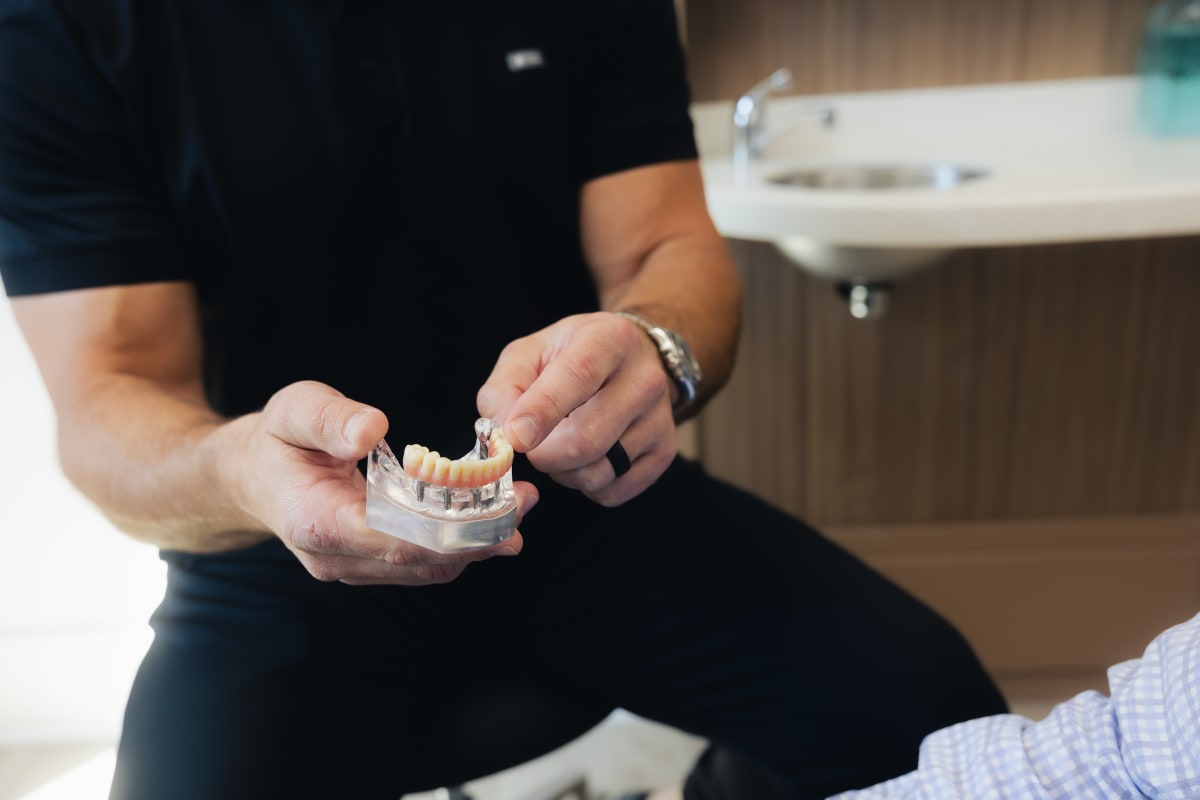
Implant Dentures Explained: All-on-X, All-on-4 & Overdentures
Evelina Smiles | Dr. Rich Constantine | Fountain Inn, South Carolina
If you've been researching ways to replace an entire arch of missing or failing teeth, you've probably encountered several different terms: implant dentures, All-on-4, All-on-X, overdentures, snap-on dentures, and fixed implant teeth.
It can get confusing quickly.
The easiest way to understand these options is to think of “implant dentures” as the broad term patients often use for a full arch of replacement teeth supported by dental implants.
Within that category, there are two primary approaches:
Removable implant dentures, commonly called overdentures or snap-on dentures, attach to dental implants for added stability but can still be removed by you for cleaning.
Fixed implant dentures, often called All-on-4, All-on-X, or fixed full-arch dental implants, are secured to dental implants and aren't routinely removed by the patient.
Both can provide significantly more stability than conventional dentures. But they create very different experiences.
At Evelina Smiles in Fountain Inn, SC, Dr. Rich Constantine helps patients understand these differences and determine which approach makes the most sense based on their bone, oral health, bite, lifestyle, and goals.
The important question usually isn't: “Do I need All-on-4 or implant dentures?”
All-on-4 is a type of implant-supported full-arch treatment.
A better question is: “Would I be better served by removable or fixed implant-supported teeth?”
Quick Takeaways
- Implant dentures is a broad term patients commonly use for full-arch teeth supported by dental implants.
- Overdentures attach to implants for stability but are removable by the patient.
- All-on-4 uses four implants to support a fixed full arch of replacement teeth.
- All-on-X follows the same fixed full-arch concept, but the number of implants isn't predetermined.
You don't need an implant for every missing tooth. - Fixed and removable implant options can both provide greater stability than conventional dentures.
- The right number of implants should be determined by your anatomy and restorative needs—not by a predetermined package.
- 3D cone beam imaging helps determine available bone, implant position, and whether grafting may be necessary.
What Does “Implant Denture” Actually Mean?
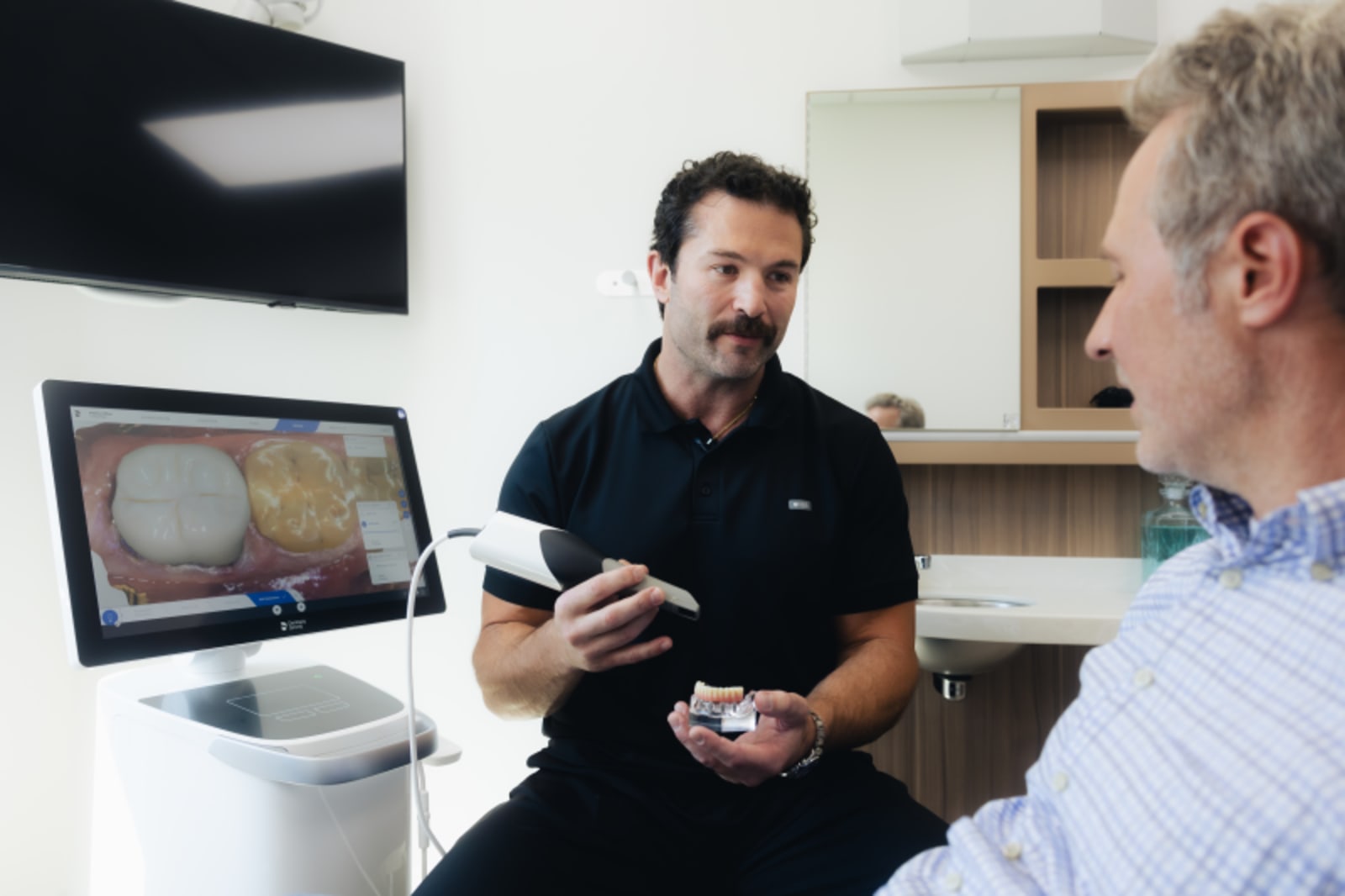
“Implant denture” isn't one specific procedure.
It's a term commonly used to describe replacement teeth that receive some or all of their support from dental implants.
That can mean something removable or something fixed.
And that's the distinction patients should understand first.
Option 1: Implant-Supported Overdentures
An implant-supported overdenture, sometimes called a snap-on denture, is removable.
The difference from a traditional denture is what helps hold it in place.
A conventional denture relies primarily on the gums, underlying ridge, suction, and sometimes adhesive for retention.
An overdenture connects to dental implants.
The implants can provide significantly greater retention and stability while you're eating, speaking, laughing, and going about your day.
You still remove the denture for cleaning and typically while sleeping, but when it's in your mouth, the implants help keep it where it belongs.
For someone struggling with a loose conventional denture—particularly a lower denture—this can be a meaningful improvement.
Why Patients Choose Overdentures
An overdenture may be worth considering if you:
- Want more stability than a traditional denture
Prefer something you can remove for cleaning
Aren't ready for a completely fixed restoration
Have anatomy that favors a removable design
Want an implant-supported option with a different level of treatment complexity or investment than fixed full-arch teeth
Overdentures do require maintenance. The attachments that connect the denture to the implants can wear over time and periodically need replacement.
Option 2: All-on-4 Fixed Implant Teeth
All-on-4 refers to a specific full-arch treatment concept in which four dental implants support a fixed set of replacement teeth.
The restoration is secured to the implants and isn't routinely removed by you.
You eat, speak, smile, and sleep with your teeth in place.
You clean around the implants and underneath the restoration at home, while your dental team monitors the implants, bone, gums, bite, and prosthesis over time.
For patients who don't want removable teeth, this can provide an entirely different experience from wearing a traditional denture.
But there's an important point:
Not every patient should automatically receive four implants.
That's where All-on-X comes in.
Option 3: All-on-X Fixed Implant Teeth
All-on-X is a broader term for fixed full-arch implant treatment.
The “X” essentially means that the number of implants isn't decided before evaluating the patient.
One patient may be appropriately treated with four implants. Another patient's bone, anatomy, bite, or restorative plan may make five, six, or another configuration more appropriate.
At Evelina Smiles, we believe your anatomy should determine the treatment—not the name of a package.
The goal isn't to use the fewest implants possible. It's to create an appropriate foundation for the teeth those implants need to support.
All-on-4 vs. All-on-X: What's the Difference?
The difference is relatively simple.
All-on-4 = four implants supporting a fixed full arch.
All-on-X = a fixed full arch supported by an appropriate number of implants based on the individual patient.
All-on-4 therefore falls within the broader All-on-X concept.
This distinction matters because full-arch implant treatment isn't simply about putting implants into available bone.
We also have to consider:
- Where the final teeth need to be positioned
- Your available bone
- Implant stability
- Your bite
- Opposing teeth
- Facial and smile support
- Cleansability
- Long-term maintenance
- The design of the final restoration
At Evelina Smiles, we plan with the final teeth in mind from the beginning.
Overdentures vs. All-on-X: The Difference Patients Usually Care About Most
Once you get past the terminology, the biggest difference is straightforward:
Overdenture = Removable
It attaches to dental implants for stability, but you take it out yourself for cleaning.
All-on-X = Fixed
It is secured to dental implants and you don't routinely remove it yourself.
Neither treatment is automatically right for every patient.
An overdenture can provide excellent stability and may be easier for some patients to clean.
A fixed restoration can provide the experience of having teeth that remain in place day and night, but it requires careful cleaning underneath the prosthesis.
The better option depends on your anatomy, health, preferences, maintenance abilities, treatment goals, and budget.
What About Traditional Dentures?
Traditional dentures remain an appropriate treatment for many patients.
But they function differently because they don't receive support from implants within the jawbone.
Instead, they rest on the gums and underlying ridge.
As the jawbone changes following tooth loss, a denture that once fit well can gradually become less stable. Adjustments, relines, adhesives, repairs, and eventual replacement may be necessary.
Dental implants create another option by providing support within the jawbone itself.
That's one reason we believe patients facing the loss of most or all of their teeth should understand implant-supported options before assuming traditional dentures are their only choice.
Why Your Jawbone Matters
Your jawbone is one of the most important factors in full-arch implant planning.
After teeth are removed, the surrounding bone gradually remodels because it no longer receives the same stimulation from natural tooth roots.
If you've been missing teeth or wearing dentures for years, you may therefore have less available bone than you once did.
That doesn't automatically mean implants aren't possible.
Depending on your anatomy, treatment may involve:
- Strategic implant positioning
- Bone grafting
- Sinus grafting
- Ridge augmentation
- A different number or distribution of implants
- A removable rather than fixed implant restoration
A 3D cone beam CT scan allows Dr. Constantine to evaluate your jaw in three dimensions and determine what's realistically possible.
What Does Full-Arch Implant Treatment Involve?

Although every case is different, treatment generally includes several phases.
1. Comprehensive Evaluation and 3D Imaging
We evaluate your remaining teeth, gums, bone, bite, smile, health history, and goals.
Cone beam imaging allows us to see the height and width of available bone as well as important structures such as nerves and sinuses.
2. Treatment Planning
We determine whether a removable overdenture or fixed restoration makes the most sense and how many implants may be appropriate.
If teeth need to be removed or grafting is necessary, those procedures are incorporated into the plan.
3. Implant Placement
The implants are placed into the jawbone.
Evelina Smiles offers both oral conscious sedation and IV sedation for appropriate patients who are anxious or undergoing more extensive treatment.
4. Temporary Teeth and Healing
Depending on your treatment plan, temporary replacement teeth may be provided while the implants heal.
For appropriately selected fixed full-arch patients, a temporary fixed restoration may sometimes be attached around the time the implants are placed.
Immediate fixed teeth aren't appropriate for everyone. Implant stability, bone, anatomy, bite, and other clinical factors determine whether this is possible.
5. Osseointegration
Over the following months, the bone integrates with the implant surfaces through a process called osseointegration.
Even if you feel comfortable relatively quickly, the implants are still healing beneath the surface.
6. Final Teeth
Once appropriate healing and implant stability have been confirmed, your final restoration can be completed.
Depending on your treatment plan, this may be an implant-supported overdenture or a fixed All-on-X restoration.
How Do You Maintain Implant Dentures?
Dental implants aren't maintenance-free.
The maintenance simply differs depending on whether your teeth are removable or fixed.
Overdentures are removed for daily cleaning. The implants and attachment components also need to be cleaned, monitored, and periodically maintained.
Fixed All-on-X restorations remain in the mouth. You'll brush them and use specialized cleaning techniques to clean around the implants and underneath the restoration.
Both require regular professional examinations and hygiene care.
Implants can't develop cavities, but the gum and bone supporting them are living tissues that can develop inflammation and disease.
Long-term maintenance is an essential part of successful implant treatment.
What Do Implant Dentures Cost?
There isn't one universal price because “implant dentures” can describe several very different treatments.
Cost can vary based on:
- Removable versus fixed teeth
- Number of implants
- One arch versus both arches
- Extractions
- Available bone
- Grafting
- Sedation
- Temporary teeth
- Final restorative materials
- Treatment complexity
An overdenture and an All-on-X restoration aren't the same treatment and shouldn't be expected to have the same investment.
At Evelina Smiles, we'll first determine what options are appropriate for you. Then we'll explain the differences, timeline, maintenance requirements, and expected investment before you make a decision.
Why Choose Dr. Rich Constantine and Evelina Smiles for Implant Dentures?

Full-arch implant treatment involves much more than placing implants.
The implants, bone, gums, bite, smile, prosthesis, and long-term maintenance all have to work together.
Dr. Rich Constantine has years of experience placing and restoring dental implants and has pursued advanced education in implant dentistry throughout his career.
He also serves as a faculty member and clinical mentor with Implant Pathway in Gilbert, Arizona, where he helps train dentists in clinical implant dentistry.
At Evelina Smiles, that experience shapes how we approach full-arch treatment:
We start with the result we're trying to create and plan backward from there.
Depending on your needs, treatment can include:
- Extractions
- Bone and sinus grafting
- Implant placement
- Implant-supported overdentures
- All-on-4 treatment
- All-on-X fixed full-arch restorations
- Temporary teeth
- Oral conscious sedation
- IV sedation
- Long-term implant maintenance
Most importantly, we're not starting with the assumption that every patient needs the same treatment.
We want you to understand why we're recommending one approach over another.
Frequently Asked Questions
Are All-on-4 and Implant Dentures the Same Thing?
All-on-4 is one type of treatment patients may refer to as an implant denture.
“Implant denture” is the broader term and can describe both removable overdentures and fixed full-arch implant restorations.
What's the Difference Between All-on-4 and All-on-X?
All-on-4 specifically uses four implants to support a fixed full arch.
All-on-X describes a fixed full-arch approach in which the number of implants is determined based on the patient's anatomy and restorative needs rather than being predetermined at four.
What's the Difference Between an Overdenture and All-on-X?
An overdenture attaches to implants but is removable by the patient.
An All-on-X restoration is fixed to the implants and isn't routinely removed by the patient.
Are More Implants Always Better?
No.
The goal is to use an appropriate number of well-positioned implants for your anatomy and restoration.
More isn't automatically better, and fewer isn't automatically better.
Can I Go From an Overdenture to Fixed Teeth Later?
Sometimes.
It depends on the location and condition of the existing implants, available bone, restorative space, and whether additional implants can be placed.
If fixed teeth are something you may eventually want, it's worth discussing that before your original implants are placed so future options can be considered during treatment planning.
What If I've Been Told I Don't Have Enough Bone?
That doesn't necessarily mean implants are impossible.
3D imaging allows Dr. Constantine to evaluate where bone remains and whether grafting, strategic implant positioning, or another implant-supported approach may be possible.
Which Option Feels Most Like Having My Own Teeth?
For patients who prioritize having teeth that remain in their mouth, a fixed All-on-X restoration generally provides a different experience from a removable overdenture or conventional denture.
However, every restoration has advantages, limitations, and maintenance requirements that should be understood before treatment.
You Don't Need to Know Which One You Need
You don't need to walk into Evelina Smiles knowing whether you need All-on-4, All-on-X, an overdenture, or another type of implant denture.
That's our job to help you determine.
If you're losing your teeth, already wearing dentures, or simply want to know whether fixed or more stable replacement teeth are possible, the first step is a comprehensive evaluation.
Dr. Rich Constantine will evaluate your teeth, bone, gums, bite, health history, and 3D imaging and help you compare your options.
We'll explain what we see, what we recommend, and why.
If you're considering implant dentures, All-on-4, All-on-X, or implant-supported overdentures in Fountain Inn, Simpsonville, Greenville, or the surrounding Upstate, call Evelina Smiles at (864) 409-7747 to schedule a consultation.
We're located at 304 Milacron Drive in Fountain Inn, South Carolina.
You don't need to choose the treatment first. Start by finding out what's possible.
